 Vatsal Shah
 You probably know how important each part of an email is.
- You capture your recipients’ attention with the subject line
- The opening line greets them and sets the tone.
- The main body carries the purpose of your message.
- The closing line usually wraps things up.
- And the signature gives your details so the reader knows exactly who you are.
But there is one part that often gets ignored — the sign off.
It may be just a couple of words before your name, but it can completely change the way your entire email feels.
In this blog, I’ll share the 20 best email sign-offs you can use in different situations so you always leave the impression you want.
So jump in and find the one that fits your style.
Email Sign-Offs – TOC
What Exactly is an Email Sign Off?
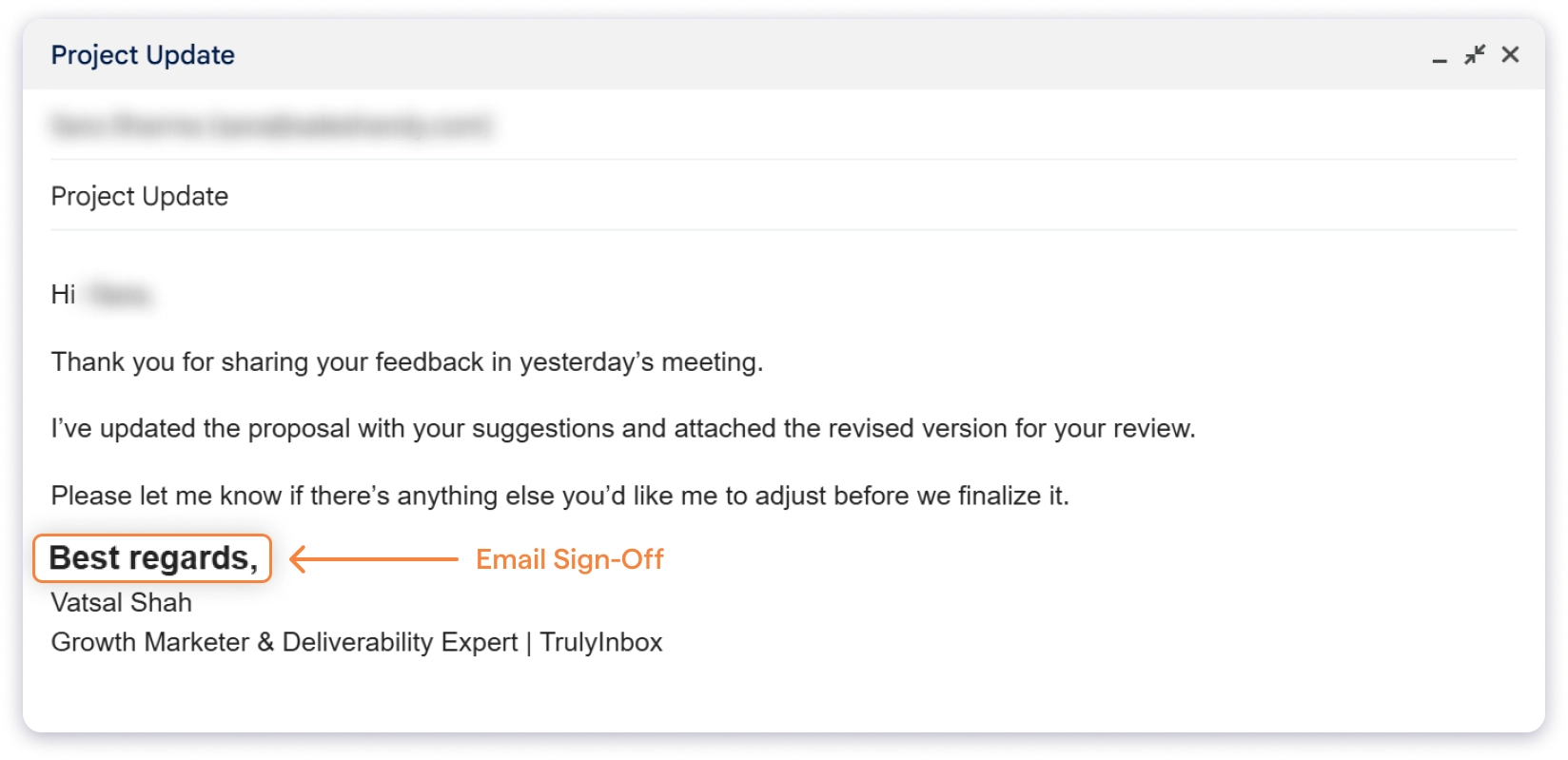
An email sign-off is the short phrase that closes your message and defines the tone you want to convey.
For example, ‘Thanks’ shows gratitude, ‘Sincerely’ sounds professional, and ‘Cheers’ feels more friendly.
20 Email Sign-Offs That Work (By Use Case)
Over the years, I’ve tried and tested multiple email sign-offs in different situations. Some worked perfectly, while others felt out of place.
The truth is, there isn’t a single “best” sign-off .
The right one depends on who you’re writing to and the tone you want to set.
I’ve grouped the 20 sign-offs into four categories:
- Professional and Business Setting
- Friendly But Neutral
- Between Colleagues and Friends
- Gen Z/Modern Style
Professional and Business Setting
If you are emailing clients, applying for a job, or reaching out in a formal context, professional sign-offs are the safest choice.
They keep you polite, respectful, and polished, which is exactly the tone you want in formal communication.
1. Thank you
You can never go wrong with Thank you. It’s polite, professional, and shows appreciation.
Use it when you want to acknowledge someone’s effort, time, or input while keeping your email formal.
2. Best regards
This is one of the most popular sign-offs in business emails. It’s safe, neutral, and professional.
You can use it when writing to clients, managers, or new contacts where you want to sound polished but not overly formal.
3. Sincerely
If you’re applying for a job or sending a formal proposal, Sincerely is a classic.
It shows respect and works best when you want your email to feel traditional and professional.
4. Respectfully
This one adds an extra layer of courtesy.
Use it when you’re writing to senior professionals or handling a sensitive topic where humility matters.
5. Yours truly
You won’t see this one as much today, but it still works in very formal settings.
You can use it if you’re writing traditional business correspondence or want to keep things extremely polite.
Friendly But Neutral
Sometimes you don’t need to sound overly formal, but you still want to stay polite and professional.
These email sign-offs are perfect when you’re emailing business partners you’ve worked with before, or anyone you want to keep a friendly yet respectful tone with.
6. Kind regards / Warm regards
Polite with a touch of warmth, making you sound approachable while still professional.
Use this when writing to colleagues, partners, or clients you already know.
7. Best
Short, simple, and safe.
Works in almost any semi-formal context when you don’t want to sound too formal.
8. Thanks again
More casual than Thank you, but still professional.
Great when the recipient has already done something helpful for you.
9. Take care
Friendly and thoughtful without being over-familiar. Perfect when you want to add a personal touch.
10. Looking forward
A forward-looking sign-off that signals positivity.
Use this when you want to keep the conversation open, especially in ongoing work relationships.
Between Colleagues and Friends
These email sign-offs are ideal when you’re emailing teammates, coworkers you’re comfortable with, or workplace friends.
You can afford to be more relaxed, they’re still safe to use in a professional environment where you already share familiarity.
11. Cheers
Probably the most popular casual sign-off in workplace culture. It’s friendly, short, and easy to use in day-to-day conversations with teammates.
You can use it when you want to sound approachable but still professional enough for office communication.
12. Catch you later
This one feels relaxed and informal, almost like you’d say it in person. It works well when writing to colleagues you interact with frequently and already have a rapport with.
It’s not something you’d use with a client, but perfect for friendly internal communication.
13. Talk soon
This keeps the conversation open while sounding casual.
It’s ideal when you expect another email, call, or meeting with the person soon. You can use it to maintain a sense of continuity without locking yourself into formality.
14. Have a great day
Upbeat and positive, this one is a nice way to close out emails when you want to leave someone in a good mood.
It feels genuine and personal, which makes it well-suited for friendly exchanges with colleagues you know well.
15. See you soon
This is a personal, conversational sign-off that works when you actually expect to meet the person in the near future.
It adds warmth to your email and feels natural when used with coworkers you’re close to.
Gen Z/Modern Style
If you’re emailing peers in a startup, creative industry, or a very casual work culture, you can get away with playful and modern email sign-offs.
These don’t fit in traditional corporate emails, but they work when the relationship is informal and the tone is light.
16. That’s enough out of me
A self-aware way to wrap up a long email.
It pokes fun at yourself for saying too much, and leaves the reader smiling instead of rolling their eyes.
17. Don’t quote me on this
Cheeky and conversational.
It is great for casual back-and-forths where you want to keep the tone light and humorous.
18. This concludes today’s episode
Perfect when your email feels like a mini story or update.
It makes routine communication feel less boring and more entertaining.
19. Reply whenever the vibe strikes
Very relaxed, almost text-message-like.
It tells the recipient there’s no urgency, and it works best when you already have an informal rapport.
20. That’s a problem for future me
Playful and relatable, especially if you’re joking about procrastination.
It shows personality, but only use it when you’re sure the recipient gets your sense of humor.
Now that you’ve seen the options, I’ll also share some common mistakes people make with email sign-offs so you know exactly what to avoid.
What Are the Common Mistakes to Avoid
If you’re thinking, “What can really go wrong with just a couple of words at the end of an email?”
The answer is – Quite a lot.
Here are some of the most common mistakes to watch out for:
- Being Too Casual in Formal Emails
- Overusing Gratitude Sign-Offs
- Mixing Your Closing Line and Sign Off
- Skipping the Sign Off Entirely
- Using Humor With the Wrong Audience
1. Being Too Casual in Formal Emails
You and I both know that “See ya” or “Later” might work with a friend, but if you drop that into a job application or client email, it instantly kills professionalism.
When the context is formal, you need to play it safe with options like Sincerely or Best regards.
2. Overusing Gratitude Sign-Offs
I get it, ‘Thanks’ feels like the easiest way to wrap up an email. But if you use it in every single message, it starts to lose its meaning.
Instead, save it for when you’re genuinely thanking someone and switch things up with ‘Kind regards’ or ‘Best’ in other situations.
3. Mixing Your Closing Line and Sign Off
Have you ever written something like ‘Looking forward’, ‘Best regards’?
I know I have, and it always feels clunky.
Your closing line and your email sign-off are two separate parts. Wrap up your thought first, then drop your email sign-off on the next line to keep it clean.
4. Skipping the Sign Off Entirely
Sometimes you might feel tempted to just end with your name.
I used to do this too, but it often comes across as rushed or even a little cold.
Even a short email sign-off, such as ‘Best’ or ‘Take care’, makes your email feel more polished and thoughtful.
5. Using Humor With the Wrong Audience
I love a witty email sign-off as much as anyone, but let’s be honest, it doesn’t always land the way you expect.
Something like ‘That’s a problem for future me’ might get a laugh from a teammate, but if you send it to a client or senior manager, it can come across as careless.
Humor works best with colleagues with whom you already have a friendly rapport with. When the audience is more formal, it’s safer to keep it simple with ‘Best regards’ or ‘Sincerely’.
Sign Off Your Emails the Right Way
Email sign-offs may seem small, but those last words can shape the impression you leave behind.
- The right email sign-off makes you sound thoughtful, professional, or approachable.
- The wrong one can make your message feel rushed, careless, or even inappropriate.
So, match your email sign-off to your recipient and the context.
Use professional options like ‘Thank you’ or ‘Sincerely’ in formal settings, keep it warm with
‘Kind regards’, or ‘Best’ when you want a friendly but neutral tone, and save the casual or witty ones for colleagues you know well.
If you start thinking of the email sign-off as the finishing touch rather than an afterthought, your emails will always feel complete and leave the impression you want.
Email Sign-Offs FAQs
1. Is it necessary to include an email sign-off every time?
Not always, but in most professional or formal contexts it’s recommended. A sign-off signals closure, politeness, and sets the right tone. Skipping it might come across as abrupt.
2. What is the best email sign-off?
There’s no universal “best.” It depends on context. For professional settings, Best regards or Sincerely work well. For colleagues, Thanks or Cheers are often effective.
3. Can I use emojis in my email sign-offs?
Only in casual or friendly emails. In professional or client-facing contexts, emojis may seem unprofessional. Use them sparingly and only if your relationship with the recipient allows it.
4. What’s the difference between an email sign-off and an email signature?
A sign-off is the closing phrase (e.g., “Best regards”), while a signature usually includes your name, role, and contact details. Both work together but serve different purposes.
5. Should I personalize my email sign-off?
Yes, when appropriate. Adding the recipient’s name or a short context-based closing (like “Thanks again for your time”) can make it more genuine.