 Vatsal Shah
 Trying to decide between TrulyInbox and InboxAlly for email warmup? You’re in the right place.
These tools use fundamentally different warmup mechanisms.
- InboxAlly runs on a seed list model.
- TrulyInbox runs on a peer-to-peer network.
That distinction changes everything.
In this blog, I’ll break down:
- How each warmup model actually works (and why it matters)
- Real pricing math at 1, 5, 10, and 20+ inboxes
- Feature-by-feature comparison across 6 categories
- Where each tool genuinely wins
- Who each tool is actually built for
- Cheaper alternatives if you need both warmup and placement testing
Full disclosure: I work with TrulyInbox. I’ll be upfront about that bias and give InboxAlly honest credit where it’s earned.
TrulyInbox Vs InboxAlly – TOC
- TL;DR: Summary of TrulyInbox Vs InboxAlly + Comparison Table
- The Core Difference Most Comparisons Miss
- TrulyInbox Vs InboxAlly Pricing Breakdown: What It Actually Costs at Scale
- TrulyInbox Vs InboxAlly Feature-by-Feature Comparison
- Where InboxAlly Wins and Who It Fits
- Where TrulyInbox Wins and Who It Fits
- Need Warmup and Placement Testing Without InboxAlly’s Price Tag?
- FAQs on TrulyInbox and InboxAlly
TL;DR: Summary of TrulyInbox Vs InboxAlly + Comparison Table
Short version: these tools solve the same problem with completely different mechanics.
The right pick depends on your use case.
- If you want a cost-efficient email warm up solution for cold emailing, TrulyInbox clearly wins.
- If you are more into email marketing and want warm-up and inbox placement testing, InboxAlly is more suited for you.
TrulyInbox uses peer-to-peer warmup. Your inbox exchanges emails with a rotating network of real users.
Key details:
- Fully automatic. No seed lists to manage
- Unlimited email accounts on every paid plan
- Starts at $29/month. Free plan available
InboxAlly uses a seed list warmup. You download a CSV of seed addresses and add them to your campaigns.
Key details:
- Seeds receive your actual campaign emails alongside real prospects
- InboxAlly engages with seeds: opens, clicks, replies, spam-to-inbox moves
- Built-in inbox placement testing shows where emails land
- Starts at $149/month for 1 sending profile and 100 seed emails
| Comparison | TrulyInbox | InboxAlly |
|---|---|---|
| Warmup Model | Peer-to-peer (automatic, rotating recipients) | Seed list (CSV, mixed into campaigns) |
| Pricing Starts At | $29/month (free plan available) | $149/month (1 profile, 100 warm up emails) |
| Email Accounts | Unlimited on every paid plan | Per-profile + seed volume based billing |
| Cost for 10 Accounts | $79/month | $1,190/mo |
| Placement Testing | Not built-in | Built-in via seed engagement |
| Domain Health Audits | SPF, DKIM, DMARC, MX Records and IP & Domain Blacklist Checks | SPF, DKIM, DMARC, MX Records, and IP & Domain Blacklist Checks |
| Content Testing | Not available | Spam triggers, subject scoring |
| Campaign Analytics | Clean (warmup separate) | Inflated by seed engagement |
| Setup | 5-min SMTP/OAuth connect | CSV download + Uploading to sending tool |
| Best For | Cold outreach, agencies, scaling | Newsletters, placement monitoring |
The Core Difference Most Comparisons Miss
The real difference is how each tool actually warms up your inbox.
Two fundamentally different mechanisms.
- How InboxAlly’s Seed List Warmup Works
- How TrulyInbox’s Peer-to-Peer Warmup Works
- Why This Distinction Actually Matters
How Does the Seed List Warmup Work in InboxAlly?
Here’s what the seed list approach looks like in practice:
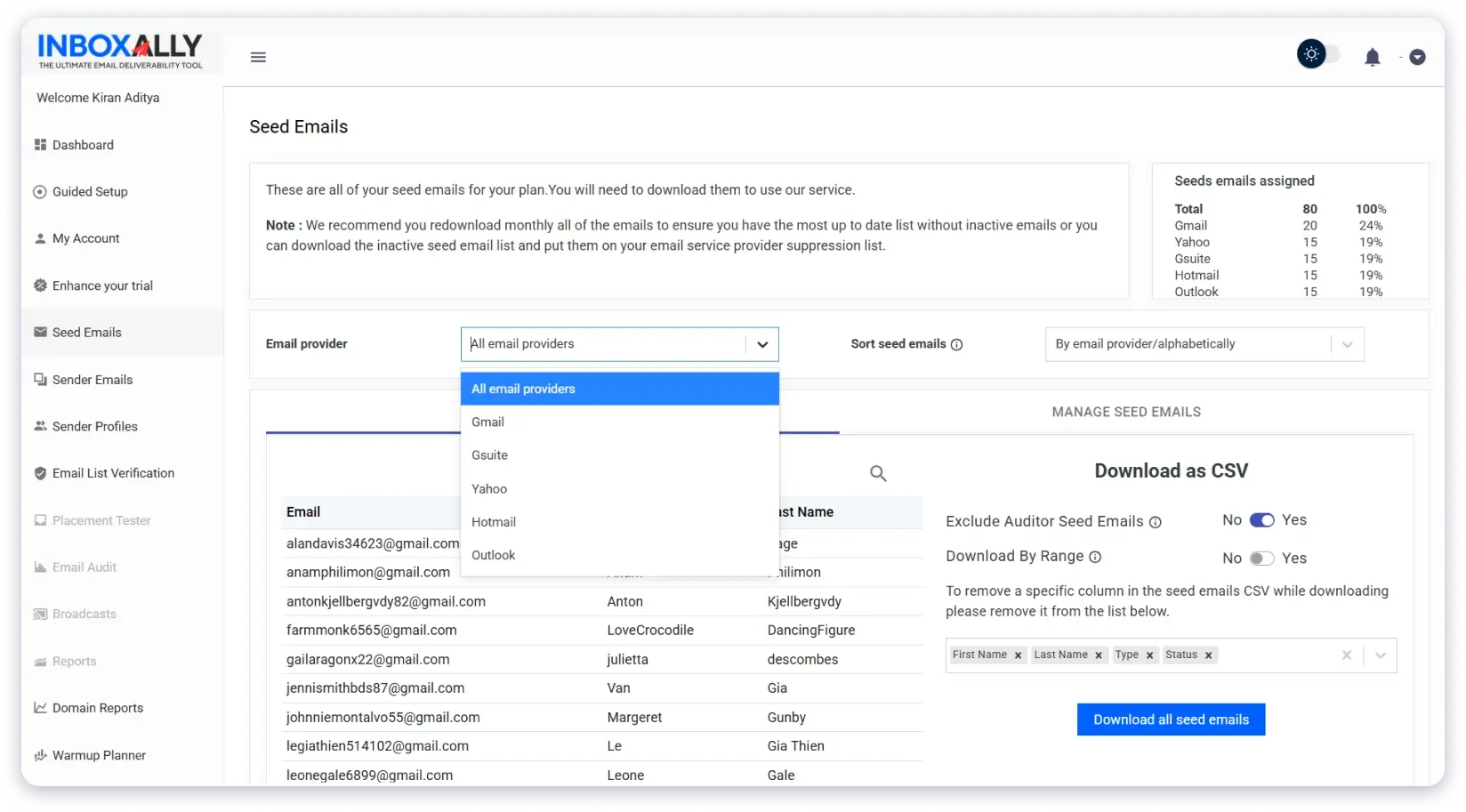
- You download a static CSV of seed email addresses from InboxAlly’s dashboard
- You manually add those seeds to your sending platform (ESP or outreach tool)
- You send actual campaigns to these seeds alongside your real prospects
- The same seed addresses receive your emails every single day
- InboxAlly performs engagement actions: opens, clicks, replies, spam-to-inbox moves
- Engagement is one-directional. You send, they engage
- InboxAlly recommends re-downloading the seed list monthly for fresh addresses
It works.
But it requires ongoing manual management. And the seeds live inside your real campaigns.
How Does the Peer-to-Peer Warmup Work in TrulyInbox?
Completely different approach:
- Connect your email account via SMTP/IMAP or OAuth. That’s the entire setup
- The tool sends warmup emails from your inbox to other real users in the network
- Those users’ accounts engage back: opens, replies, spam-to-inbox moves
- You’re sending to a rotating pool of unique recipients daily. Not the same list
- It’s bi-directional. You send AND receive. Natural conversation threads build up
- No CSV downloads. No seed lists. No mixing warmup into your campaigns
Connect once, configure settings, forget about it. Warmup runs entirely in the background.
Why This Distinction Actually Matters
This isn’t just a technical detail.
It affects your workflow in four concrete ways.
- Recipient Patterns ESPs Notice
- One-Directional vs Bi-Directional Sending
- Campaign Analytics Pollution
- Operational Overhead
1. Recipient Patterns ESPs Notice
Nobody emails the same 100 people every day. Gmail and Outlook detect repetitive patterns.
With InboxAlly, your account hits the same seeds daily. With TrulyInbox, you reach different mailboxes regularly.
That mimics real human behavior.
2. One-Directional vs Bi-Directional Sending
InboxAlly’s engagement is one-way. You send to seeds, they engage. That’s it.
With peer-to-peer, your inbox sends AND receives. You get real replies. Conversation threads build naturally.
ESPs evaluate that back-and-forth when judging sender legitimacy.
3. Campaign Analytics Pollution
This catches people off guard. InboxAlly seeds engage with your actual campaigns.
Your open rates and click rates get inflated.
With TrulyInbox, warmup runs independently. Campaign metrics reflect real prospect behavior only.
4. Operational Overhead
InboxAlly requires monthly CSV re-downloads and manual ESP integration.
Risk of accidentally removing seeds mid-campaign.
TrulyInbox requires a 5-minute initial setup. After that, nothing.
TrulyInbox Vs InboxAlly Pricing Breakdown: What It Actually Costs at Scale
Plan names are meaningless without context.
What matters is the actual cost for the number of inboxes you need.
- InboxAlly uses per-profile pricing.
- TrulyInbox uses volume-based pricing.
At 1 inbox, the difference is notable. At 10 or 20, it’s dramatic.
InboxAlly Pricing
InboxAlly has 4 paid plans.
Each plan is based on the number of seed emails and sender profiles you can have.
| Plan | Price/mo | Seeds/Day | Profiles |
|---|---|---|---|
| Starter | $149 | $100.00 | $1 |
| Plus | $645 | 500 | 5 |
| Premium | 1,190 | 1,000 | 10 |
| Enterprise | Custom | Thousands | Unlimited |
TrulyInbox Pricing
There are 4 paid plans and a free-forever plan in TrulyInbox.
You can connect unlimited email accounts for warm-up in any plan.
And the plans are based on the daily warm-up email volume you can send
| Plan | Price/month | Warmup Emails/Day | Email Accounts You Can Connect | Reply Rate |
|---|---|---|---|---|
| Free | $0 | $10.00 | 1 | 10% |
| Starter | $29 | 100 | Unlimited | 25% |
| Growth | 79 | 1,000 | Unlimited | 45% |
| Scale | $189 | 3,000 | Unlimited | 60% |
| Business | $289 | 6,000 | Unlimited | 65% |
Check out the pricing page for more details!
The Real Cost: Side by Side
Here’s what you actually pay to warm up 1, 5, 10, and 20+ accounts:
| Scenario | InboxAlly | TrulyInbox |
|---|---|---|
| 1 Account | $149/month | $29/month or $0 (Free) |
| 5 Accounts | $645/month | $29/month |
| 10 Accounts | $1,190/month | $79/month |
| 20+ Accounts | Custom ($2,000+/month est.) | $79/month |
The math is straightforward:
- 1 account: InboxAlly is 5.1x more expensive
- 5 accounts: InboxAlly is 8-22x more expensive
- 10 accounts: $1,190/mo vs $79/month. That’s 15x the saving!
- 20+ accounts: InboxAlly requires custom enterprise pricing. TrulyInbox stays $79/month
If you’re running cold outreach, you likely need 10-50+ warm inboxes. Per-profile pricing doesn’t scale for that.
One more detail: TrulyInbox has a forever-free plan and 7-day free trials on all paid plans.
InboxAlly offers a limited “Try for free” option but no permanent free tier.
TrulyInbox Vs InboxAlly Feature-by-Feature Comparison
Pricing is only part of the decision.
Here’s how both tools compare across every major feature.
- Warm-Up Approach
- Inbox Placement Testing
- Domain Health & Technical Audits
- Content Testing
- Integrations
- Setup & Ease of Use
Warm-Up Approach
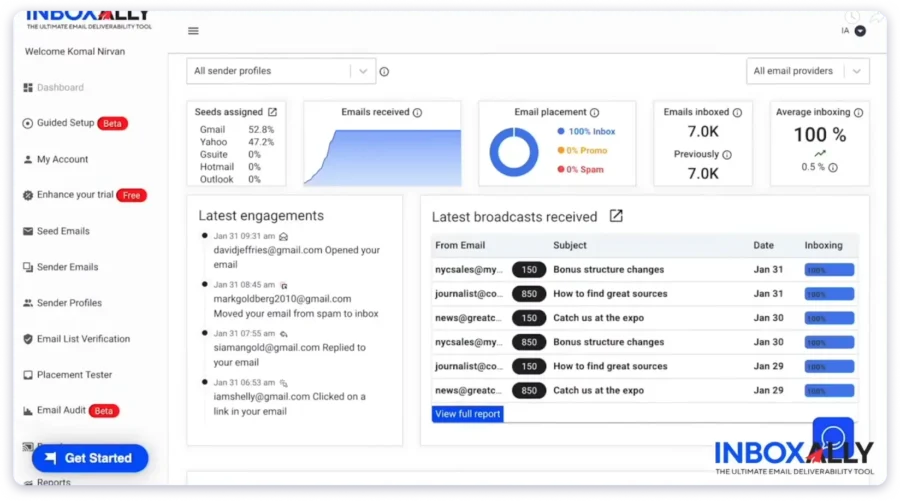
InboxAlly gives you structured warmup planner presets:
- Reputation Repair for damaged sender reputation
- Reputation Boost for building up new domains
- Reputation Protect for maintaining good standing
Each preset adjusts seed engagement volume and type. You get strategic control over the warmup trajectory.
The downside?
The underlying mechanism sends to the same static seeds daily. ESPs can detect that repetitive pattern.
TrulyInbox takes a behavior-simulation approach:
- AI-generated warmup emails with variable timing and natural language
- Rotating unique recipients from the peer-to-peer pool daily
- Engagement looks organic because it mimics how real people email
- It also gives you advanced warmup features like:
- Warm-up Strategy Settings
- Reply Rate Customization
- Email Sending Schedule
- Recipients’ ESP Prioritization
This makes the warmup pattern inherently more natural.
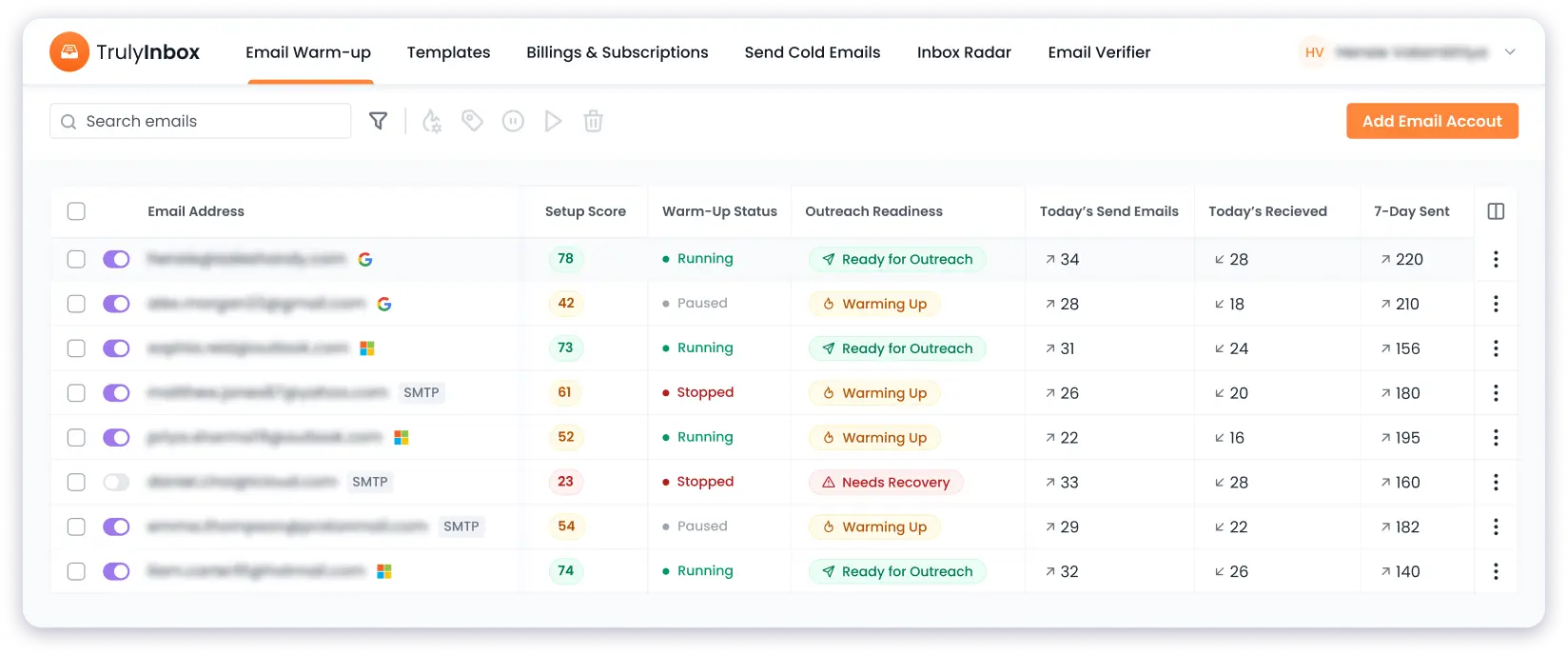
Verdict: Different philosophies. InboxAlly gives strategic control. TrulyInbox creates more natural behavior.
For cold email, natural signals matter more.
Inbox Placement Testing
InboxAlly wins this category outright.
Because seeds sit inside your actual campaigns, you see exactly where emails land. Gmail inbox, Outlook promotions, Yahoo spam.
Real-time visibility into live campaign deliverability.
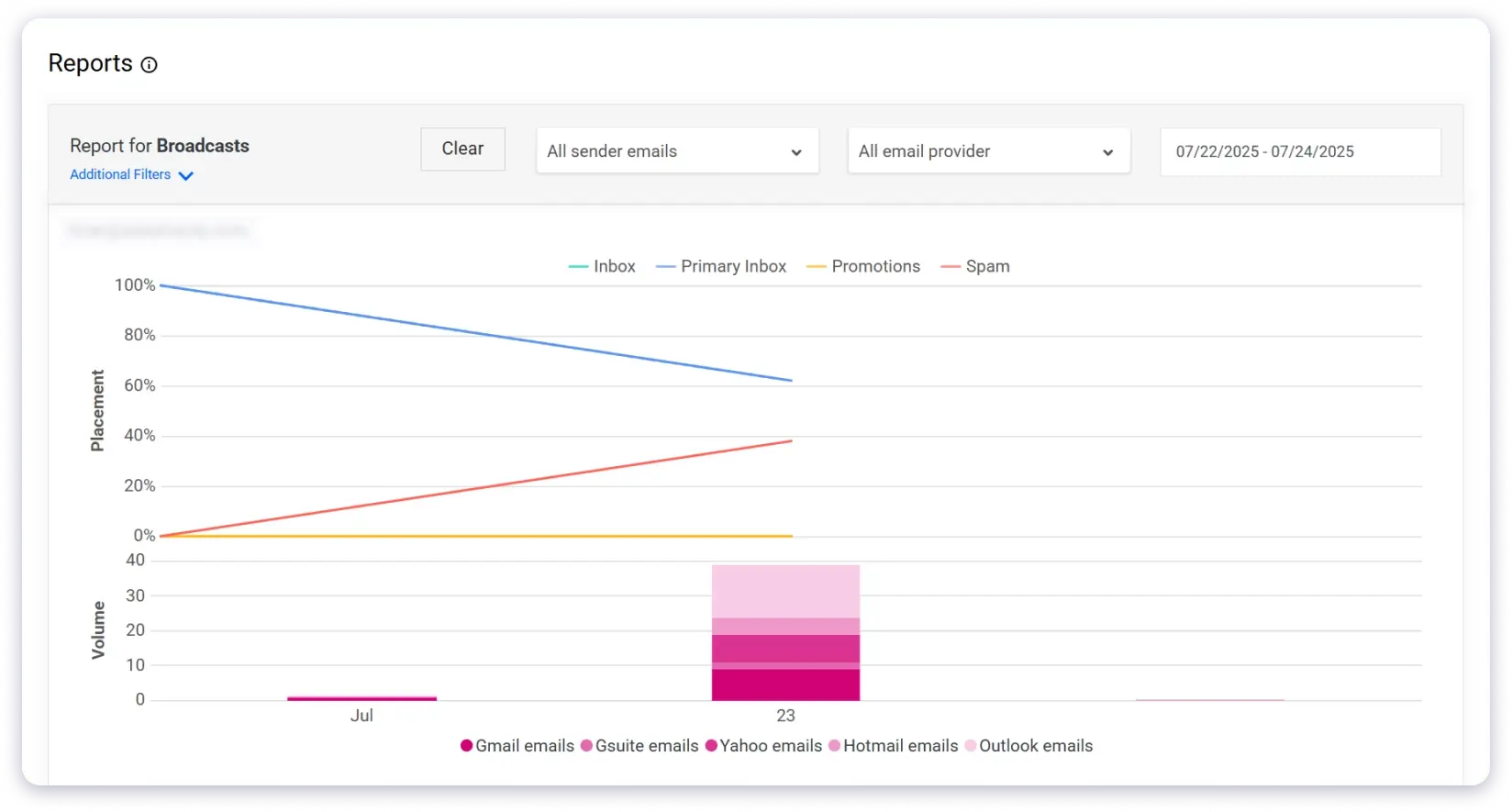
TrulyInbox doesn’t offer placement testing natively. It’s a dedicated warmup tool.
If you need placement testing alongside TrulyInbox, Inbox Radar ($23/month by Saleshandy) provides:
- ESP-level placement insights
- Spam score reports
- Office 365 support (which InboxAlly doesn’t offer)
Verdict: InboxAlly wins here.
That said, there are other tools that will give both warm up and inbox placement testing at a more resonable cost. Keep reading to know them!
Domain Health & Technical Audits
Both InboxAlly and TrulyInbox provide domain health checks.
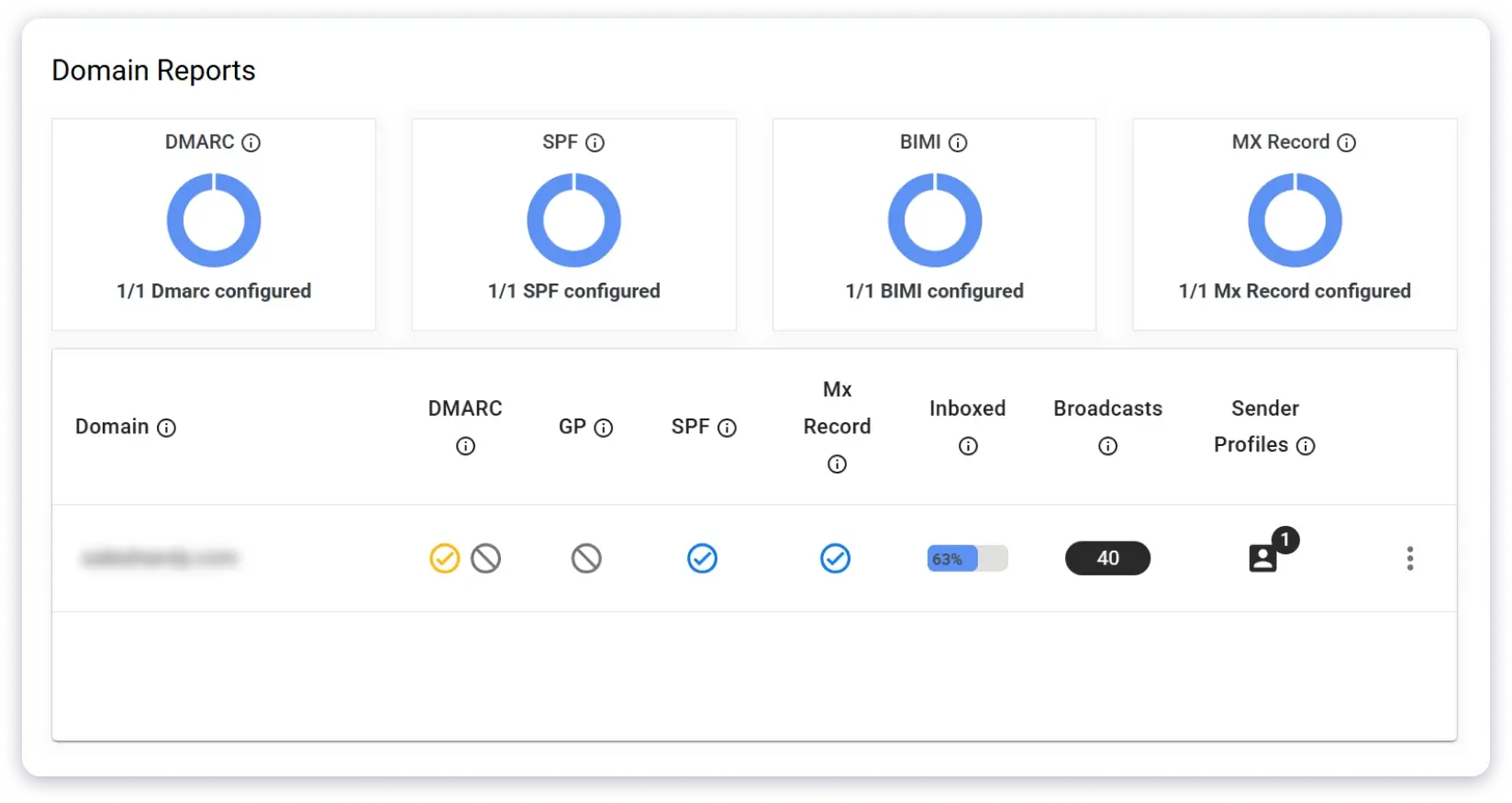
SPF, DKIM, DMARC, and MX record verification are covered in both dashboards.
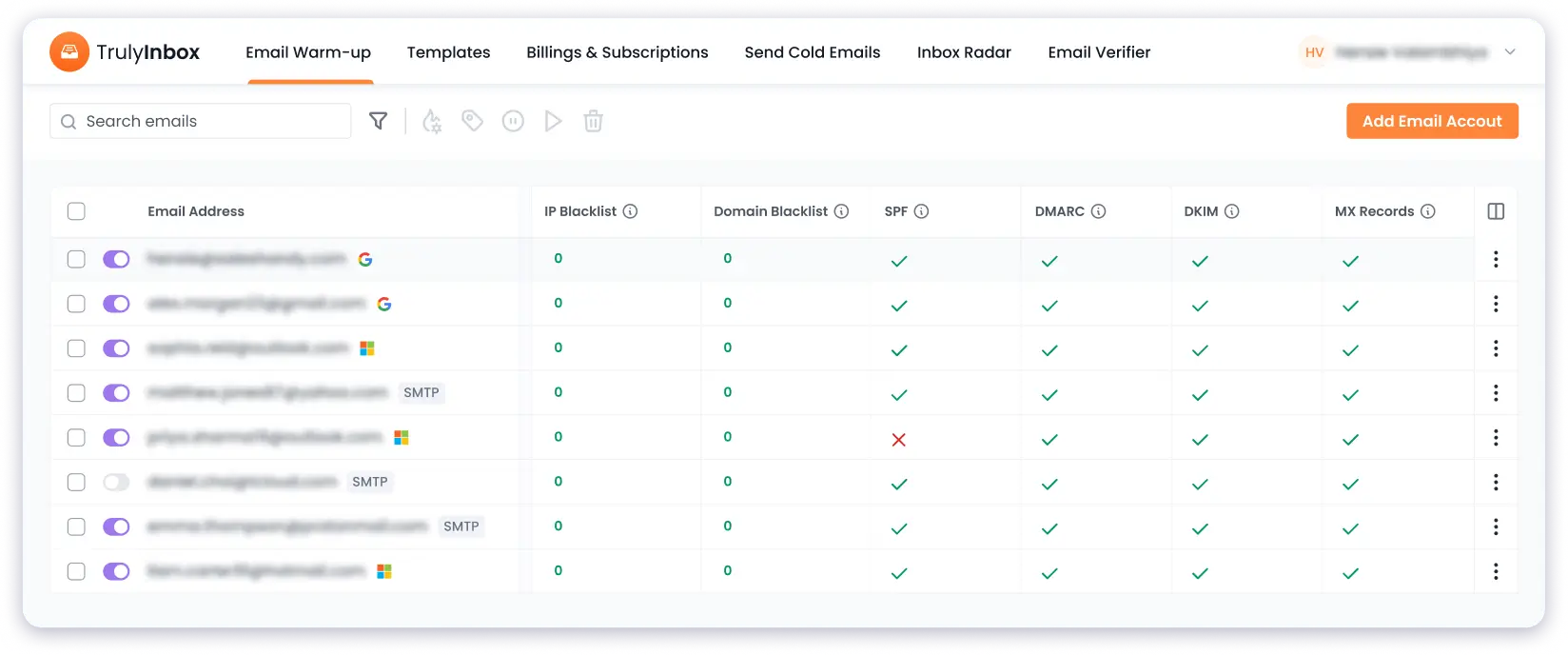
Apart from this, both platforms also check for blacklisting of your IP and Domains.
Verdict: It’s a tie.
Content Testing
InboxAlly flags spam trigger words and scores subject lines. Also offers AI rewrite suggestions.
Useful for pre-send optimization.
TrulyInbox doesn’t offer content testing.
Verdict: InboxAlly wins.
Integrations
InboxAlly integrates with HubSpot. Beyond that, no deep platform connections.
It works with any ESP since you’re adding seed emails manually.
TrulyInbox sits inside the Saleshandy ecosystem:
- Domain buying to warmup to outreach in one connected workflow
- Native integration if you’re already using Saleshandy for cold email
Verdict: TrulyInbox wins for cold email workflow. InboxAlly is more of a standalone tool.
Setup & Ease of Use
InboxAlly has an onboarding checklist and demo data. The dashboard is more complex because it houses multiple features.
Expect a learning curve.
TrulyInbox takes about 5 minutes:
- Connect via SMTP/IMAP or OAuth
- Configure warmup settings
- Done. Minimal dashboard, no learning curve
Verdict: TrulyInbox is faster to get running. InboxAlly has more control but takes longer to learn.
Where InboxAlly Wins and Who It Fits?
I’m not going to pretend InboxAlly doesn’t have real strengths. For certain use cases, it’s genuinely the better pick.
InboxAlly’s real strengths:
- Inbox placement testing. See exactly where emails land across Gmail, Outlook, Yahoo in real-time. No free tool replicates this integration level
- All-in-one dashboard. Domain audits, content scoring, placement testing, and warmup in one interface
- Strong customer support. Chat and phone on higher plans. Weekly progress sessions on Premium. G2: 4.6/5. Trustpilot: 4.7/5
- Warmup planner presets. Repair, Boost, and Protect strategies tailored to your current deliverability status
- Newsletter/marketing fit. Embedding seeds into actual sends boosts engagement signals for that specific campaign in real-time
Pick InboxAlly if you’re:
- A newsletter or marketing sender who needs campaign-level placement monitoring
- A team that wants domain audits, content testing, and warmup in one dashboard
- An enterprise org with budget for premium deliverability tools
- Managing only 1-2 sending accounts (the price gap is smaller here)
- Someone who values structured warmup presets and strategic control
Where TrulyInbox Wins and Who It Fits?
TrulyInbox’s advantages aren’t just about being cheaper. They’re a direct result of the peer-to-peer model.
TrulyInbox’s real strengths:
- Unlimited accounts on every paid plan. No per-profile billing. Warm 5 inboxes or 50. Same price
- Natural engagement patterns. Rotating recipients, bi-directional threads, variable timing. Looks like real human behavior to ESPs
- Clean campaign analytics. Warmup runs separately. Open rates and reply rates reflect actual prospect behavior only
- Zero operational overhead. No CSV downloads. No monthly refreshes. No risk of breaking campaigns. Connect once, done
- Saleshandy ecosystem. Domain buying, warmup, and outreach in one connected workflow
- Forever-free plan. 1 account, 10 emails/day. Test before committing. All paid plans include 7-day free trials
- 5-minute setup. SMTP/IMAP or OAuth. Configure settings. That’s it
Pick TrulyInbox if you’re:
- Running cold outreach with 5-50+ inboxes
- An agency managing multiple client accounts at scale
- A freelancer or small team watching costs
- Anyone who wants a set-and-forget warmup with zero management
- A user who needs clean campaign metrics without seed inflation
- Already using or considering Saleshandy for outreach
Need Warmup and Placement Testing Without The Huge Price Tag?
You might be thinking:
“I need warmup AND placement testing. Am I stuck with InboxAlly?”
Not necessarily. A few options worth considering.
TrulyInbox + Inbox Radar
This is the combination I’d recommend for most cold email use cases:
- TrulyInbox ($29-79/month): Peer-to-peer warmup for unlimited accounts
- Inbox Radar ($23/month): ESP-level placement insights, spam score reports, O365 support
- Combined cost: $52-102/month for unlimited warmup + placement testing
- InboxAlly comparison: $149/month for 1 sending profile
Disclosure: Both TrulyInbox and Inbox Radar are Saleshandy ecosystem products. I’m transparent about that.
Other tools to consider
If you haven’t committed to a standalone warmup tool yet, look at complete outreach platforms.
Tools like Saleshandy, Smartlead, and Instantly bundle warmup with their sending stack.
Depending on your workflow, an all-in-one platform might make more sense than buying warmup separately.
For a deeper look at alternatives, check out my list of InboxAlly alternatives.
FAQs on TrulyInbox and InboxAlly
1. Is TrulyInbox better than InboxAlly?
For cold email outreach with multiple inboxes, yes. Peer-to-peer warmup, unlimited accounts, and much lower cost make it the practical choice.
For newsletter senders who need campaign-level placement testing, InboxAlly’s seed list approach has genuine value. It depends on use case.
2. How much does InboxAlly cost for 10 email accounts?
InboxAlly’s Premium plan costs $1,190/month for 10 sending profiles. TrulyInbox warms up 10 accounts for $79-189/month with unlimited accounts on every paid plan.
3. Does TrulyInbox offer inbox placement testing?
Not yet natively. TrulyInbox focuses on warmup. For placement testing, add Inbox Radar ($23/month) for ESP-level insights and spam score reports.
Inbox placement testing is also on TrulyInbox’s product roadmap.
4. What’s the difference between seed list and peer-to-peer warmup?
Seed list warmup (InboxAlly) requires downloading a CSV and sending campaigns to those addresses alongside real prospects. One-directional engagement.
Peer-to-peer warmup (TrulyInbox) connects your inbox to a network of real users who exchange warmup emails automatically. Bi-directional. No CSV, no campaign mixing.
5. Can I use InboxAlly and TrulyInbox together?
Technically yes. But there’s rarely a reason to. TrulyInbox handles warmup. If you need placement testing, Inbox Radar ($23/month) is the more cost-effective complement.
4. Does InboxAlly have a free plan?
No. InboxAlly starts at $149/month for 1 profile with a limited “Try for free” option.
TrulyInbox offers a forever-free plan (1 account, 10 warmup emails/day) plus 7-day free trials on all paid plans.