 Vatsal Shah
 If you want more replies, more booked meetings, and more deals from your cold emails, you are in the right place.
Sending more emails alone no longer works. Sending the right emails does.
In this blog, I will share the exact cold email strategy you can use to achieve consistent results in 2026.
By the end of this blog, you will know how to:
- Build a strong cold email infrastructure
- Create a clean and relevant cold emailing list for outreach
- Write personalized and relevant emails that will stand out and get guaranteed replies
- Get your emails into the Primary inbox instead of Promotions or Spam
- Finally, find and double down on what is working.
So jump in and get started!
Cold Email Strategy – TOC
Quick Summary of The Cold Email Strategy To Win in 2026
In 2026, you need the right balance of volume, precision, intent, and relevance so your cold emails land in inboxes, get opened, and finally get positive replies.
Here is a quick overview of the strategy:
- Get your Ideal Customer Profile (ICP) right by narrowing down who you are targeting, why they would care right now, and what problem they already recognize
- Set up your cold email infrastructure properly so your emails consistently land in the Primary inbox
- Find relevant prospects and build clean, well-segmented cold email lists instead of sending to broad audiences
- Create personalized cold email sequences with one clear opening email and 3 to 4 follow-up emails
- Frameworks, like PAS, AIDA, etc., and personalization methods such as images or videos
- Keep emails short, contextual, and focused on starting conversations instead of pitching
- Track replies and meetings closely, and scale only what proves to work
This is the high-level strategy. I have covered each part in more detail below, so keep reading!
The Cold Email Strategy to Book 10 Qualified Meetings Every Week
Many cold emailers fall into the trap of believing that sending more emails automatically leads to more replies and booked meetings.
In reality, cold email success is more about targeting the right people at the right time with the right message.
If it sounds cliché, yes, it is, but that is what actually works!
Here is a real example from Anil Salvi, CMO & CRO at Saleshandy, that reinforces this point.
If you also want to post such success posts on LinkedIn, here are the exact steps you need to follow:
- Get Your Ideal Customer Profile (ICP) and Buyer Persona Right
- Set Up Your Cold Email Infrastructure
- Prepare Your Infrastructure for Outreach
- Find Relevant Prospects and Build Segmented Cold Emailing Lists
- Create Your Personalized Cold Email Copies
- Create Your Follow-Ups
- Test Inbox Placement of Your Inboxes Before Sending
- Monitor Replies, Test Variations, and Double Down on What Works
1. Get Your Ideal Customer Profile and Buyer Persona Right
The first foundation you need to get right is finding the right people.
This is where your Ideal Customer Profile (ICP) and Buyer Persona come into play.
- In your ICP, you define the ideal company that would benefit from your services or products.
- In the Buyer Persona, you define the person(s) you should connect with in the ideal companies.
Together, they will help you and your team align priorities and reach out to people relevant to your business.
Your ICP and Buyer Persona directly influence:
- Which prospects you target and how you segment your cold emailing lists
- How your cold email messaging is framed through pain points and solutions
- The relevance and quality of replies you receive
So, getting this foundation right sets the stage for everything else in your cold email strategy.
What to Define in Your Ideal Customer Profile
When defining your ICP, you should be clear on company-level attributes.
Here are a few
- Business Model – B2B or B2C
- Industry and Niche
- Company Stage or Maturity
- Company Size
- Revenue Range
- Location
- Growth intent
- Existing Tech Stack or Process
These criteria help you narrow down companies that are well aligned with what you offer.
What to Define in Your Buyer Persona
Once your ICP is defined, the next step is identifying the right Buyer Persona.
Some key characteristics to define in your Buyer Persona include:
- Role or Function
- Level of Seniority
- Decision Involvement
- Problems or Pain Points Faced
- Ownership of the Problem
- Internal Influence
- Typical Objections or Constraints
These are just some of the factors you should clearly define when building your ICP and Buyer Persona.
When these are well defined, every step that follows becomes simpler and more effective.
2. Set Up Your Cold Email Infrastructure
After you have your targeting in place, the next step is building a reliable sending infrastructure.
This is important as it directly impacts your email deliverability, that is, if your emails will make it to the Primary inbox
This includes:
- Your Secondary Domains
- Email Accounts for Sending
- Cold Email Software to manage sending, sequencing, and tracking
- Separate IPs (optional)
Let me break it down.
1. Secondary Domain
You must always use separate domains for cold emailing.
Cold email involves outreach to people who have not interacted with you before.
This naturally carries a higher risk of low engagement, spam complaints, or filtering. In the worst case, you can be blacklisted and unable to send emails!
So to avoid putting your brand and reputation at risk, always purchase and set up separate domains for cold outreach.
For example, if your primary domain is trulyinbox.com, your secondary domains can be:
- gettrulyinbox.com
- trytrulyinbox.com
- trulyinboxoutreach.com
Also, make sure you purchase your secondary domains from reputable domain registrars.
Once you have your secondary domains, set up domain forwarding so any visits to those domains redirect to your primary website.
This adds legitimacy and ensures prospects who check your domain see a real brand presence.
2. Email Accounts
Once your secondary domains are ready, the next step is setting up email accounts under those domains.
These email accounts will be used exclusively for cold outreach, so they need to be configured carefully from day one.
Your email addresses should look human and professional.
Use real-looking formats such as:
- firstname@secondarydomain
- firstname.lastname@secondarydomain
This improves credibility and reduces suspicion when recipients see your emails.
As a best practice, you should limit the number of email accounts to a maximum of 3 to 4 inboxes per domain.
The main step is choosing your email service provider (Google Workspace, Microsoft 365, Zoho, etc.).
Choose a provider with a strong reputation, reliable infrastructure, and proper authentication support.
Cutting corners at this stage often leads to deliverability issues that are difficult to fix later.
3. Cold Email Software
Once your domains and email accounts are in place, you need cold email software to manage outreach at scale.
Cold email software acts as the control layer for your entire outreach system.
It allows you to send emails safely, run sequences, manage follow ups, and track performance without manual effort.
A reliable cold email tool should help you:
- Manage multiple inboxes and domains in one place
- Create and automate email sequences with follow ups
- Control daily sending limits and sending windows
- Monitor replies and engagement
- Pause or adjust campaigns based on performance
Choose software that prioritizes deliverability, offers proper inbox rotation, and gives you clear insight into what is working and what is not.
My Recommendation: Saleshandy – An AI-Powered Cold Outreach Automation Platform.
4. Separate IPs (Optional)
Using separate IPs for cold email is highly optional and usually required only at higher sending volumes.
For most early stage or moderate scale outreach setups, shared IPs provided by reputable email service providers are sufficient and often safer.
Separate IPs become relevant when:
- You are sending high volumes consistently
- You want full control over IP reputation
- You have the technical capability to monitor and maintain IP health
If you choose to use separate IPs, they must be warmed up carefully, just like domains and inboxes.
Also Read: How to Easily Warm Up Your Domains Before Outreach in 2026
3. Prepare Your Infrastructure for Outreach
Before any real outreach, your inboxes need to be warmed up properly.
Email warm up is the process of gradually building trust and reputation for your new inboxes by simulating natural sending and engagement behavior.
This step is critical for ensuring your emails land in the Primary inbox when campaigns go live.
As a general rule, you should warm up each inbox for at least 14 to 21 days before launching outreach.
Also Read: Does Email Warm Up Work in 2026?
4. Find Relevant Prospects and Build Segmented Cold Emailing Lists
While your new accounts are warming up, you should use this time to prepare your cold email prospect lists.
- Shortlist companies that closely match your ICP
- Identify relevant contacts within those companies
- Verify email addresses to avoid bounces
- Segment prospects based on industry, size, or intent
By the time your warm up is complete, your lists should be clean, segmented, and ready for outreach.
This way, you can start campaigns confidently without rushing list quality or compromising deliverability.
Also Read: Top 5 Places to Buy Reliable Email Lists in 2026
5. Create Your Personalized Cold Email Copies
Once your lists are ready, the next step is writing cold email copies that start conversations.
The goal of your first email is not to sell, it is to get a reply.
Effective cold emails are short, specific, and clearly relevant to the recipient.
They show that you understand the company context and why reaching out now makes sense.
A strong cold email copy should include:
- A clear reason for reaching out
- One relevant problem the prospect likely recognizes
- A simple and low pressure call to respond
Personalization should focus on context, not compliments.
Mentioning recent company activity, growth signals, or role specific challenges works far better than surface level personalization.
Keep your emails concise.
Long explanations, feature lists, or aggressive pitches reduce reply rates and trigger filtering.
When done correctly, your copy should feel like a thoughtful message from a real person, not a sales template.
6. Create Your Follow-Ups
Most replies and meetings come from follow ups, not the first email.
If you stop after one message, you are leaving results on the table.
Your follow ups should not repeat the same message.
Each follow up should add clarity, context, or a different angle on the same problem.
A strong follow up strategy:
- Uses three to four follow up emails
- Adds new context or insight each time
- Keeps messages short and respectful
- Stops once it is clear there is no interest
Follow ups work best when they feel helpful rather than persistent. Avoid pressure or urgency language.
The goal is to make it easy for the prospect to respond when the timing is right.
7. Test Inbox Placement of Your Inboxes Before Sending
Before launching any campaign, you should confirm that your emails are landing in the Primary inbox.
Inbox placement testing helps you understand how email providers are treating your messages.
Sending without testing is a common mistake that leads to poor results and false conclusions about copy or targeting.
You should test inbox placement:
- After warm up is complete
- Before starting a new campaign
- Whenever you add new inboxes or domains
If emails consistently land outside the Primary inbox, pause outreach and fix deliverability before proceeding.
Also Read: Top 5 Inbox Placement Tools to Maximize Deliverability in 2026
8. Monitor Replies, Test Variations, and Double Down on What Works
Once campaigns are live, optimization becomes your focus.
Do not judge performance based on open rates alone. Focus on metrics that lead to meetings.
Track:
- Positive replies
- Conversations started
- Meetings booked
- Performance by segment
Test one variable at a time, such as messaging angle, subject line, or segmentation. Avoid changing multiple elements at once, as it makes results unclear.
- When something works, scale it carefully.
- When something underperforms, pause it early.
Cold email success comes from continuous feedback and adjustment, not from one perfect campaign.
By monitoring results closely and doubling down on what proves effective, you turn cold email into a predictable and repeatable meeting booking channel.
Put Theory Into Sending Emails and Closing Deals
Cold emailing is not about chasing volume, shortcuts, or copy tricks.
It is about building a system that works consistently and improves over time.
In 2026, the teams that win with cold email are the ones sending the right emails, to the right people, at the right time, and learning from every campaign they run.
Use this strategy as a framework.
Apply it step by step.
Track what works.
Refine what does not.
That is how cold email turns from a theory into a repeatable revenue channel in 2026.
Cold Email Strategy – FAQs
1. How Many Emails per Day Should I Send per Inbox When I Start, and When I Scale?
In the first week after warm up, keep sending between 5 to 10 emails per inbox per day.
Increase gradually every few days based on inbox placement and replies.
A safe long term range for most setups is 35 to a maximum of 50 emails per inbox per day.
Scaling in cold email comes from adding inboxes, not pushing more volume from the same inbox.
When performance drops, pause and stabilize instead of increasing sends.
2. How Do I Know If My Inbox Is Warmed Up?
Ideally, it takes 4 weeks to warm up.
After the warm-up period, you should run an inbox placement test to see where your emails are actually landing.
If your emails are landing in the Primary inbox, your warm-up worked.
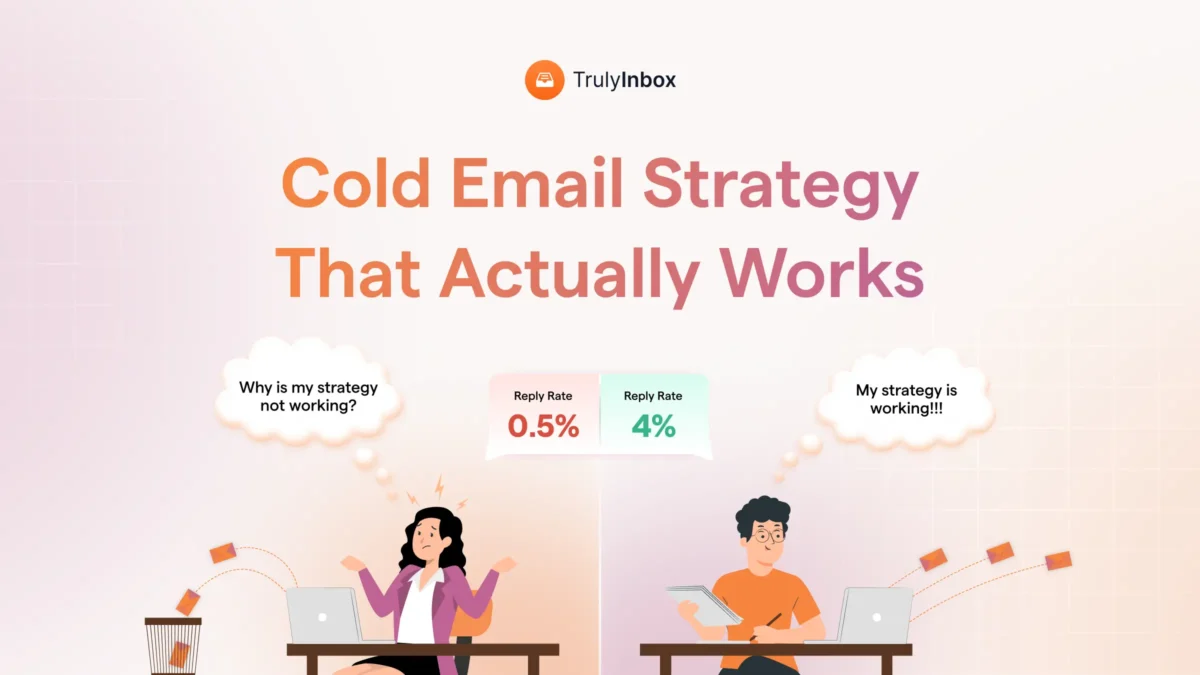
3. What Is a Realistic Reply Rate and Meeting Booking Rate to Aim for in 2026?
For well targeted campaigns in 2026:
- A positive reply rate of 3 to 4% is standard, 5 to 10% is very good
- Meeting booking rate of 1 to 3% is healthy
Lower reply rates usually point to targeting or relevance issues.
Replies without meetings usually point to positioning or qualification issues.
Focus on reply quality over raw reply volume.
4. How Do I Rotate Domains and Inboxes Safely Without Hurting Deliverability?
Rotate at the inbox level, not randomly.
Best practices:
- Spread sends evenly across inboxes
- Keep daily limits consistent per inbox
- Retire inboxes that show declining placement
- Introduce new domains gradually, not all at once
Never move volume aggressively from a struggling inbox to a fresh one. Fix the issue first, then scale again.
5. If I Am Selling Something New and Prospects Do Not Recognize the Problem Yet, How Do I Approach Cold Email Without Sounding Pushy?
Do not sell the solution first.
Start by highlighting a symptom or pattern the prospect already experiences.
Your goal is to start a conversation, not educate fully or convince in the first email. Ask questions that make them reflect rather than react.
When awareness is low, relevance and timing matter more than persuasion.