
Most cold email senders hear the same advice when deliverability drops. “Check your Sender Score.” It sounds simple enough.
But here’s the problem. Most people don’t understand what the number actually measures, who calculates it, or whether it even applies to their setup.
I run TrulyInbox, an email warm-up tool. I’ve checked hundreds of Sender Scores across client accounts and my own sending domains.
This guide breaks down what the score measures and where to check it.
I’ll cover the six factors that affect it, the tools you should actually use, and a step-by-step improvement playbook.
You’ll also get specific advice for cold email senders that most guides skip entirely.
TL;DR — What Sender Score Is and Why It Matters
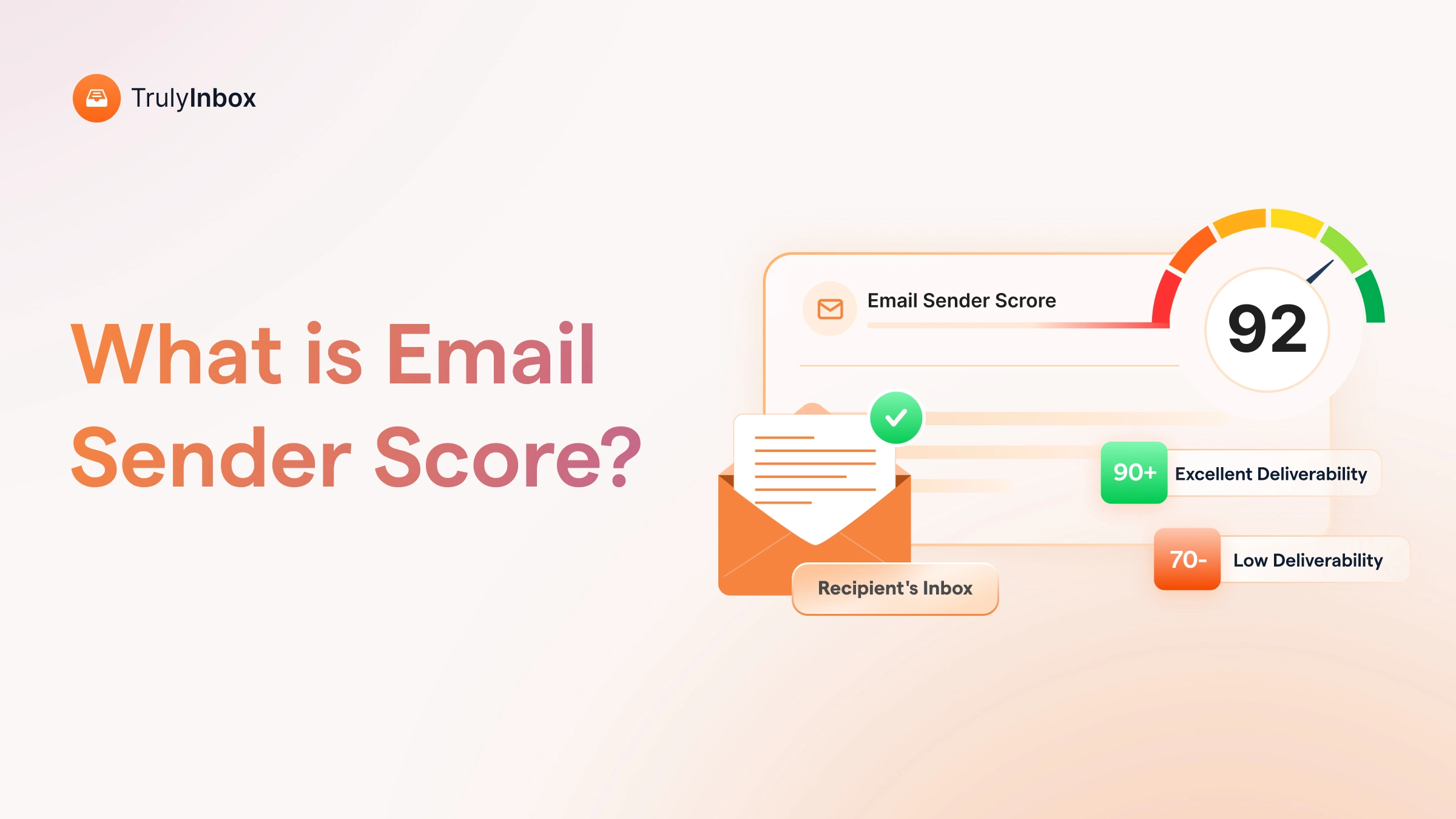
Sender Score is a 0 to 100 reputation rating for your sending IP address. Validity, the company behind Return Path, calculates it.
The score uses a rolling 30-day window and compares your sending behavior against all other tracked IPs.
- Scores above 80 signal good deliverability.
- Scores below 70 point to serious inbox placement problems.
The score reflects spam complaints, bounce rates, spam trap hits, blocklist presence, and sending volume consistency.
Here’s the nuance most guides miss.
Sender Score is IP-based, and cold emailers on Google Workspace or M365 share IPs with thousands of other senders.
Your individual domain reputation, tracked by Google Postmaster Tools and Microsoft SNDS, matters more for your inbox placement than the shared IP’s Sender Score.
- For email marketers on dedicated IPs, Sender Score is directly actionable.
- For cold emailers on shared infrastructure, it’s a useful signal but not the full picture.
You can improve it by cleaning your lists, verifying emails before sending, and authenticating with SPF, DKIM, and DMARC.
Warming up new domains gradually, keeping complaint rates under 0.1%, and monitoring through Google Postmaster Tools alongside Sender Score also helps.
I’ll break down each factor below, show you how to check your score for free, and share the specific steps that work for cold email setups.
What Is Sender Score?
Sender Score is a free email reputation metric from Validity. Validity, formerly known as Return Path, created and maintains it.
The score assigns a number from 0 to 100 to your sending IP address. Think of it like a credit score, but for email.
It works as a percentile ranking. A score of 85 means your IP outperforms 85% of all other tracked IPs in Validity’s network.
The score updates based on a rolling 30-day average of your sending behavior. So recent activity matters more than what happened three months ago.
Validity pulls the data from its Data Network. This is a cooperative network of over 80 mailbox and security providers worldwide.
One important distinction needs to be clear here. Sender Score is not calculated by Gmail, Outlook, or Yahoo. Those providers run their own internal reputation systems.
Sender Score is a third-party approximation, not a direct input into any mailbox provider’s inbox placement decisions. I’ve verified this directly. Validity’s network feeds the score, but Gmail and Microsoft make their own decisions using separate algorithms.
Most competitor guides define Sender Score without clarifying this. That missing context leads senders to treat the score as gospel when it’s actually one data point among several.
Sender Score vs Sender Reputation — They’re Not the Same
This distinction trips up most senders. The two terms sound interchangeable, but they measure different things.
Sender reputation is the actual judgment each mailbox provider makes. Gmail, Outlook, and Yahoo each use their own proprietary signals to decide where your emails land.
Sender Score is a third-party estimate of that reputation. Validity calculates it from their data network as a diagnostic tool, not a decision-making system.
Here’s a simple way to think about it. Sender reputation is your actual creditworthiness, and Sender Score is one credit bureau’s approximation of it.
This matters because the two don’t always align. I’ve seen accounts with Sender Scores above 80 still hitting spam in Gmail because their domain reputation in Google Postmaster Tools showed “Low.”
The reverse also happens. You can have a mediocre Sender Score and still reach inboxes if your domain reputation with specific providers is strong.
What does this mean in practice? You need to check your email reputation across multiple systems, not just senderscore.org.
If your Sender Score looks fine but emails still land in spam, the problem likely sits at the domain reputation level.
In that case, you’ll need to improve your email reputation with the providers that matter to your audience.
What Sender Score Range Means for Your Emails
Not all scores carry the same weight. Here’s what each range signals about your sending behavior and likely inbox placement.
90–100 — Excellent
This is the target range for high-volume senders on dedicated IPs. Your sending behavior looks highly trustworthy at this level.
Inbox placement is rarely blocked. Most emails reach the inbox without friction.
80–89 — Good
A score in this range indicates generally healthy sending behavior. Minor issues like small bounce spikes or occasional complaints may prevent a perfect score.
Most emails will still reach the inbox. You’re in solid shape here.
70–79 — Fair
Mailbox providers start treating your IP with increased caution at this level. Some filtering, throttling, or delays become likely.
This range signals that one or more key metrics need attention. Don’t ignore a score in the 70s. It often precedes a sharper drop.
According to Return Path’s benchmark data, a score drop from 83 to 70 can reduce delivery rates by roughly 20%. That’s a significant hit from a seemingly small decline.
Below 70 — Poor
A score below 70 means significant deliverability problems. Your emails face a high risk of landing in spam or getting blocked entirely.
This requires immediate investigation and remediation. Waiting will only make recovery harder.
One important note for cold emailers. These brackets reflect IP-level behavior. If you send through Google Workspace or M365, your score reflects the shared IP, not just your own activity.
A mediocre score might not mean you personally have a problem. It could mean other senders on your shared IP are dragging it down.
That’s why cold emailers need to check domain reputation alongside Sender Score. The IP score alone doesn’t tell your full story.
What Factors Affect Your Sender Score
Six core signals influence your Sender Score. Each one carries weight, and they interact with each other.
1. Spam Complaints
When recipients hit “Mark as Spam,” it sends a direct negative signal. Even a small complaint rate above 0.1% can hurt, especially on smaller lists.
For cold emailers, this is the highest-risk factor. Recipients didn’t opt in to your emails. Every message carries a complaint risk that opted-in newsletters don’t face.
2. Bounce Rates
Hard bounces, meaning emails sent to invalid or closed addresses, indicate poor list hygiene. High bounce rates signal to reputation systems that you’re not maintaining your list.
For cold emailers, email verification before sending is non-negotiable. You should target a bounce rate under 2%, and ideally under 1%.
3. Spam Trap Hits
Spam traps come in two types. Recycled traps are old email addresses that ISPs repurpose to catch senders with stale lists.
Pristine traps are addresses that never belonged to a real person. Providers plant these specifically to catch scraped or purchased lists.
Hitting either type causes severe, sometimes immediate score drops. There is no safe number of spam trap hits.
Even one signals a list quality problem.
4. Sending Volume and Consistency
Erratic spikes in volume look suspicious to reputation systems. Sending nothing for weeks and then blasting a large batch raises red flags.
Consistent, predictable sending builds trust over time. For cold emailers, this is exactly why warm-up matters.
It establishes a stable volume pattern before outreach begins.
5. Blocklist Presence
If your IP appears on industry blocklists like Spamhaus or the Return Path Blocklist, your score drops immediately. Some blocklists carry more weight than others.
Cold emailers should monitor blocklists proactively. Tools like MXToolbox can check your IP against 100+ blocklists for free.
6. Engagement Signals (Opens, Clicks, Replies)
Positive engagement tells reputation systems that recipients want your emails. Low engagement weakens your reputation over time.
For cold emailers, reply rate is the most important engagement signal.
It proves human interaction, which carries more weight than opens or clicks alone.
How to Check Your Sender Score (Free Tools)
Checking your Sender Score is just the starting point.
You need a monitoring stack, not a single tool, to understand your full reputation picture.
Here are the five tools I recommend, and when to use each one.
1. SenderScore.org (Validity’s Official Tool)
This is Validity’s free IP reputation lookup. Enter your sending IP or domain to see your 0 to 100 score.
The tool shows a score breakdown by category, including complaints, spam traps, and unknown users. You’ll need a free account to access detailed reports.
- Best for: Email marketers on dedicated IPs
- Limitation: Shows IP-level data only, not domain reputation
2. Google Postmaster Tools
Google offers this free tool for monitoring domain and IP reputation specifically with Gmail. It shows data that Sender Score can’t provide.
You get visibility into:
- Domain reputation (High, Medium, Low, or Bad)
- IP reputation
- Spam rate
- Authentication success rates
- Encryption status
This is the tool cold emailers should check first. I check Google Postmaster Tools weekly across all my sending domains.
It shows me things Sender Score can’t, like whether Gmail specifically is flagging my domain even when my IP score looks fine.
3. Microsoft SNDS (Smart Network Data Services)
Microsoft’s equivalent tool monitors your reputation with Outlook and Hotmail. It shows IP reputation data, spam complaint rates, and trap hits.
- Best for: Senders targeting Microsoft mailboxes
- Limitation: IP-level only, requires IP ownership verification
4. MXToolbox
MXToolbox is a free blocklist checker that scans your IP against 100+ blocklists.
It also checks your DNS records for SPF, DKIM, and DMARC configuration.
- Best for: Quick health checks before launching campaigns
- Bonus: Catches blocklist issues before they snowball
5. Mail-Tester.com
Send a test email to a unique address and get a deliverability score out of 10. Mail-Tester checks authentication, content quality, blocklist status, and spam filter triggers.
- Best for: Pre-campaign checks to catch issues before they reach real recipients
- Limitation: Free tier limits the number of daily checks
The key takeaway here is simple. Don’t rely on Sender Score alone for your email reputation check.
Use the right tool for the right purpose, and check multiple sources before drawing conclusions.
Why Sender Score Matters Differently for Cold Email Senders
This is the section that cold emailers need most.
Email marketers typically use dedicated IPs through ESPs like Mailchimp, Brevo, or ActiveCampaign.
Their Sender Score reflects their individual sending behavior. The score is directly actionable for them.
Cold emailers operate differently.
Most send through shared infrastructure, primarily Google Workspace or Microsoft 365. The IP behind your emails is shared with thousands of other senders.
Your Sender Score reflects the collective behavior on that IP, not just yours.
You can do everything right and still see a mediocre score because someone else on your shared IP is sending spam.
I see people run warm-up across hundreds of accounts on Google Workspace. The Sender Scores for those shared IPs fluctuate based on what other senders on the same IP are doing, not just their behavior.
What actually matters for cold emailers is domain reputation.
Google Postmaster Tools and Microsoft SNDS track this per-domain, not per-IP.
This gives you data about your sending behavior specifically.
Here’s what cold emailers should monitor instead of obsessing over Sender Score:
- Domain reputation via Google Postmaster Tools
- Spam complaint rate
- Bounce rate
- Inbox placement test results
- Warm-up engagement metrics
Sender Score remains a useful general signal. But if you’re on shared infrastructure, treat it as context rather than a verdict.
How to Improve Your Sender Score — 9 Steps That Actually Work
These nine steps work for both email marketers and cold emailers. I’ve included specific callouts for cold email senders where the approach differs.
1. Verify Your Email List Before Sending
Use email verification tools to remove invalid, disposable, and catch-all addresses before every campaign.
Target a bounce rate under 2%, and ideally under 1%.
For cold emailers, verify every list before loading it into your outreach tool.
A single unverified list import can spike bounces and damage your score in one send.
2. Authenticate Your Sending Domain (SPF, DKIM, DMARC)
Authentication is non-negotiable in 2026. Google, Yahoo, and Microsoft now enforce these standards.
Here’s what each record does:
- SPF tells receiving servers which IPs can send from your domain
- DKIM adds a cryptographic signature proving the email wasn’t altered
- DMARC ties SPF and DKIM together and instructs providers on handling unauthenticated mail
Set up all three before sending a single outreach email. Missing even one weakens your email deliverability significantly.
3. Keep Spam Complaint Rate Below 0.1%
Google’s hard limit is 0.3%, but best practice targets under 0.1%. Exceeding either threshold triggers filtering.
For cold emailers, three things keep complaints low:
- Make unsubscribe easy to find
- Avoid misleading subject lines
- Don’t email people who’ve already said no
Monitor your complaint rate through Google Postmaster Tools. It updates faster than Sender Score.
4. Clean Inactive Contacts Regularly
For email marketers, remove subscribers who haven’t engaged in 90+ days.
Dead contacts drag down engagement ratios and signal poor list management.
For cold emailers, the same principle applies differently.
Don’t re-email prospects who never responded after a full sequence. They’re dead weight that hurts your engagement metrics.
5. Send Consistently and Avoid Volume Spikes
Reputation systems prefer stable, predictable sending patterns.
Sudden spikes, like sending zero emails for weeks and then 500 in a day, look suspicious.
For cold emailers, ramp volume gradually. Start at 5 to 10 emails per day on a new domain and increase over 3 to 4 weeks.
6. Warm Up New Domains and IPs Before Outreach
New sending domains start with zero reputation. Mailbox providers don’t trust them by default.
Warm-up establishes a positive sending pattern before cold outreach begins. Gradual volume increases combined with positive engagement signals build trust with providers.
A safe ramp-up rate is 2 to 3 emails per day increase, or roughly 20% daily.
Pushing faster than this risks triggering spam filters.
Read More: How to Easily Warm Up Your Domains Before Outreach in 2026
7. Segment and Personalize Your Sends
Sending the same generic message to everyone produces low engagement. Low engagement damages your reputation over time.
For email marketers, segment by interest, activity, or lifecycle stage. For cold emailers, personalize based on the prospect’s role, company, or recent activity.
Reply rate is your most important reputation signal as a cold emailer. Personalization drives replies.
Read More: How to Build a Cold Email List That’s Clean, Accurate, & Ready To Send
8. Monitor Metrics After Every Campaign
Track these metrics after each send:
- Bounce rate
- Complaint rate
- Open rate
- Reply rate
- Inbox placement
Look for patterns. If bounces spike after importing a new list, that source is the problem.
Don’t wait for Sender Score to drop. Campaign metrics are your early warning system.
9. Check Blocklists Proactively
Use MXToolbox or similar tools to check your domain and IP against 100+ blocklists regularly. Catching a listing early prevents cascading damage.
If you find your IP or domain listed:
- Identify the cause (spam trap hit, complaint spike, etc.)
- Fix the underlying issue
- Submit a removal request
Some blocklists auto-delist after behavior improves. Others require manual removal requests.
How Email Warm-Up Helps Protect Your Sender Score
Email warm-up is the process of gradually increasing sending volume on a new or inactive domain.
During warm-up, you generate positive engagement signals that build trust with mailbox providers.
Here’s how warm-up directly impacts the Sender Score factors covered earlier.
- Volume consistency. Warm-up establishes a stable sending pattern. This is exactly what reputation systems look for. Instead of going from zero to hundreds overnight, you ramp gradually.
- Engagement signals. Warm-up emails get opened, replied to, and moved from spam to inbox. Every one of these actions sends a positive signal to mailbox providers.
- Complaint avoidance. Warm-up uses consenting participants, so complaint rates stay at zero. This protects your score during the critical early days.
- Bounce prevention. Warm-up sends to verified, active addresses. This means zero bounces during the period when your reputation is most fragile.
Warm-up doesn’t inflate your Sender Score artificially. It builds the behavioral foundation that a healthy score reflects.
You should warm up in three situations:
- Before launching cold email campaigns on a new domain
- After a period of sending inactivity
- After recovering from a deliverability hit
I built TrulyInbox, so I’ll keep this focused on the concept rather than a product pitch. The principle applies regardless of which tool you use.
The mechanism does matter, though.
Peer-to-peer warm-up, where real inboxes exchange real emails, works differently from seed-list tools that simulate engagement.
Mailbox providers can detect artificial patterns, so the quality of warm-up interactions matters.
A typical warm-up follows a phased approach.
Phase 2, the early ramp, increases volume without cold outreach.
Phase 3 holds at around 50 warm-up emails per day through week 4.
Cold emails don’t start until Phase 4, when warm-up drops to a maintenance level of 15 to 20 per day.
FAQs About Sender Score
1. What is a good Sender Score?
A score above 80 is considered good. Scores between 80 and 89 indicate healthy sending behavior with minor issues.
Scores of 90 and above are excellent and rarely face inbox placement problems.
If your score drops below 70, you likely have significant deliverability problems that need immediate attention.
2. How do I check my Sender Score for free?
Go to senderscore.org and enter your sending IP address or domain. You’ll need a free account for detailed reports.
For a more complete picture, also check Google Postmaster Tools for Gmail reputation and Microsoft SNDS for Outlook reputation.
No single tool tells the full story.
3. Does Sender Score affect cold email deliverability?
Indirectly. Sender Score measures IP reputation, but cold emailers on Google Workspace or M365 share IPs with other senders.
Your individual domain reputation, tracked by Google Postmaster Tools, has more direct impact on whether your cold emails reach the inbox.
4. How long does it take to improve Sender Score?
Typically 2 to 4 weeks of consistent, healthy sending behavior. Sender Score uses a rolling 30-day average, so improvements show up gradually.
Severe issues like blocklist hits or spam trap exposure may take longer to recover from.
5. What is the difference between Sender Score and sender reputation?
Sender Score is a third-party metric from Validity that estimates your IP’s reputation on a 0 to 100 scale.
It is the actual judgment each mailbox provider makes using their own algorithms. Sender Score approximates reputation. It doesn’t control it.
6. Can email warm-up improve my Sender Score?
Yes. Warm-up builds the positive sending signals that Sender Score measures. These include consistent volume, high engagement, zero complaints, and zero bounces.
Warm-up is most effective for new domains with no sending history or domains recovering from deliverability problems.
7. Is Sender Score the same for IP and domain?
No. The original Sender Score from Validity is IP-based. However, domain reputation, tracked separately by Gmail and Microsoft, has become equally or more important for deliverability. This is especially true for senders on shared infrastructure like Google Workspace.

 Yash Jain